Table of Contents
A meditation on e^{iπ} + 1 = 0

In the vast landscape of mathematics, certain results stand as monuments to human ingenuity. Among them, one equation rises above the rest — not for its complexity, but for its impossible elegance:
This is Euler's identity, and it has been called the most beautiful equation in mathematics by everyone from Richard Feynman to Keith Devlin. But what makes five symbols on a page so profoundly moving?
Euler's identity brings together five of the most fundamental constants in mathematics:
Each constant arises from a different branch of mathematics. That they should meet in a single equation — with no extraneous coefficients, no arbitrary adjustments — borders on the miraculous.
Euler's identity is a special case of the more general Euler's formula:
This formula, published by Leonhard Euler in 1748, establishes a deep connection between exponential functions and trigonometry through complex numbers. When we substitute :
Rearranging gives us the identity:
The proof emerges naturally from Taylor series. Consider the three expansions:
When we substitute into the exponential series and separate real and imaginary parts, the cosine and sine series appear as if by design. The powers of cycle through , perfectly sorting the terms into their trigonometric homes.
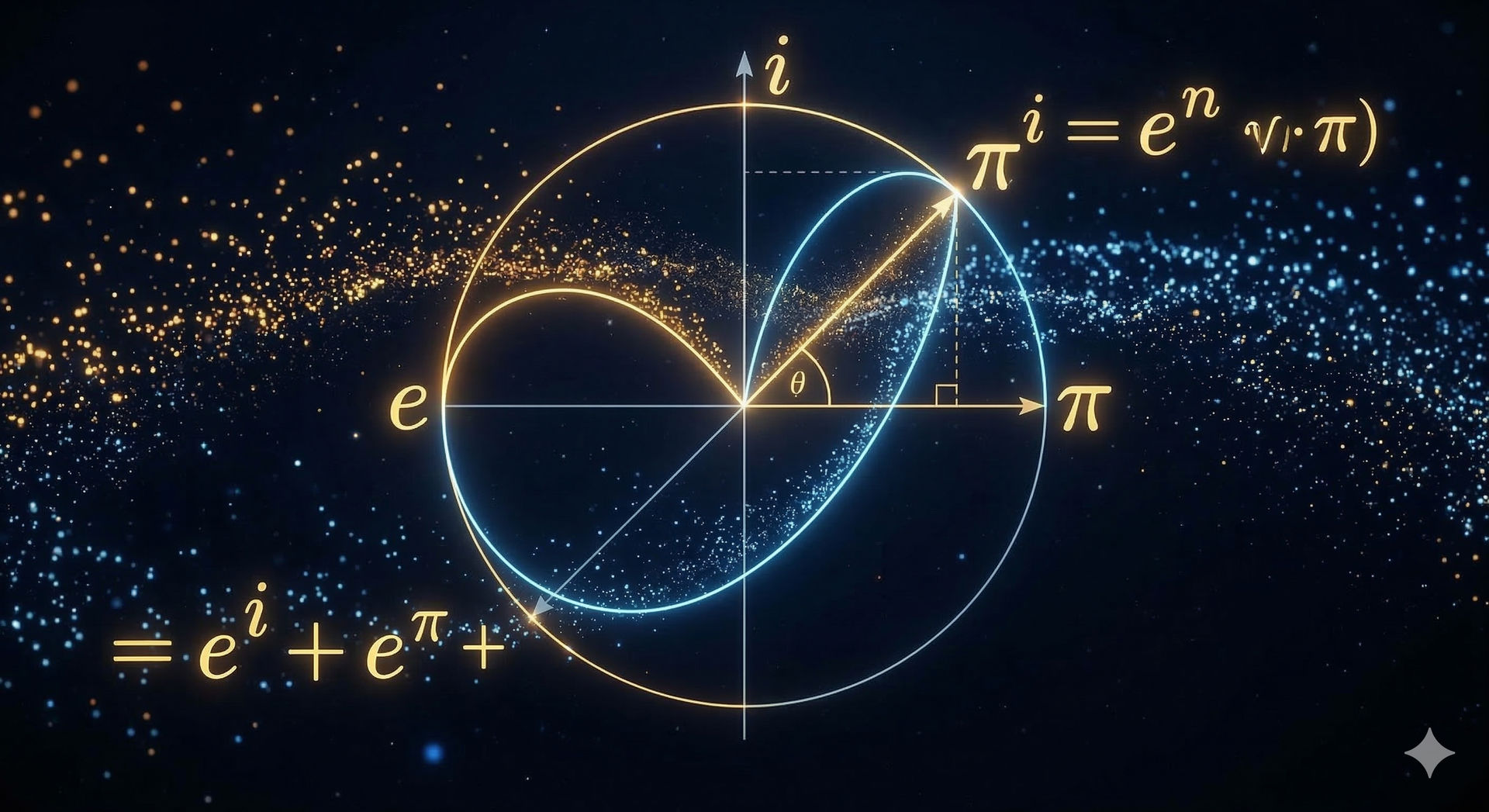
There is an elegant geometric interpretation. In the complex plane, the expression traces the unit circle as varies from to . Starting at the point , we walk counterclockwise. At , we arrive at exactly .
This is Euler's identity made visible: walking halfway around the unit circle — a journey of radians — lands us at . The equation is simply the statement that half a revolution negates your position.
For the skeptic, computation confirms what theory guarantees. Here is a direct numerical check in Python:
import cmath
import math

# Compute e^(i*pi) directly
result = cmath.exp(complex(0, math.pi))

print(f"e^(iπ) = {result}")
print(f"e^(iπ) + 1 = {result + 1}")
print(f"|e^(iπ) + 1| = {abs(result + 1):.2e}")

# Output:
# e^(iπ) = (-1+1.2246467991473532e-16j)
# e^(iπ) + 1 = (1.2246467991473532e-16j)
# |e^(iπ) + 1| = 1.22e-16
The result is not exactly zero due to floating-point arithmetic, but the magnitude is on the order of — machine epsilon. In the world of numerical computation, this is as close to zero as we can get.
Why do mathematicians use the word "beautiful" for an equation? The philosopher Bertrand Russell wrote that mathematics possesses "a beauty cold and austere... sublimely pure, and capable of a stern perfection such as only the greatest art can show."
Euler's identity embodies this aesthetic because it exhibits:
The physicist Richard Feynman, upon encountering the identity as a teenager, wrote in his journal: "The most remarkable formula in mathematics." He was not alone. In a 1990 survey by the Mathematical Intelligencer, readers voted Euler's identity the most beautiful theorem in mathematics.
Euler's formula is not merely decorative. It is the workhorse of electrical engineering, quantum mechanics, and signal processing. Every time an engineer uses phasors to analyze AC circuits, every time a physicist writes a quantum state as a superposition of complex exponentials, Euler's formula is at work.
The identity is the purest distillation of this machinery — a reminder that the deepest structures in mathematics are also the most useful.
Mathematics, at its best, reveals order hiding beneath apparent chaos. Euler's identity takes five numbers — born in arithmetic, geometry, analysis, and algebra — and shows that they were always connected, always part of a single, coherent story.
That is why mathematicians call it beautiful. Not because it is pretty, but because it is true in a way that illuminates everything around it.
"Like a Shakespearean sonnet that captures the very essence of love, or a painting that brings out the beauty of the human form, Euler's equation reaches down into the very depths of existence." — Keith Devlin

Applied mathematician and AI practitioner. Founder of MathLumen, exploring mathematics behind machine learning and scientific AI.

How ratios, frequencies, and transforms create harmony
From Pythagorean tuning to the Fast Fourier Transform, mathematics and music have been intertwined for millennia. We...
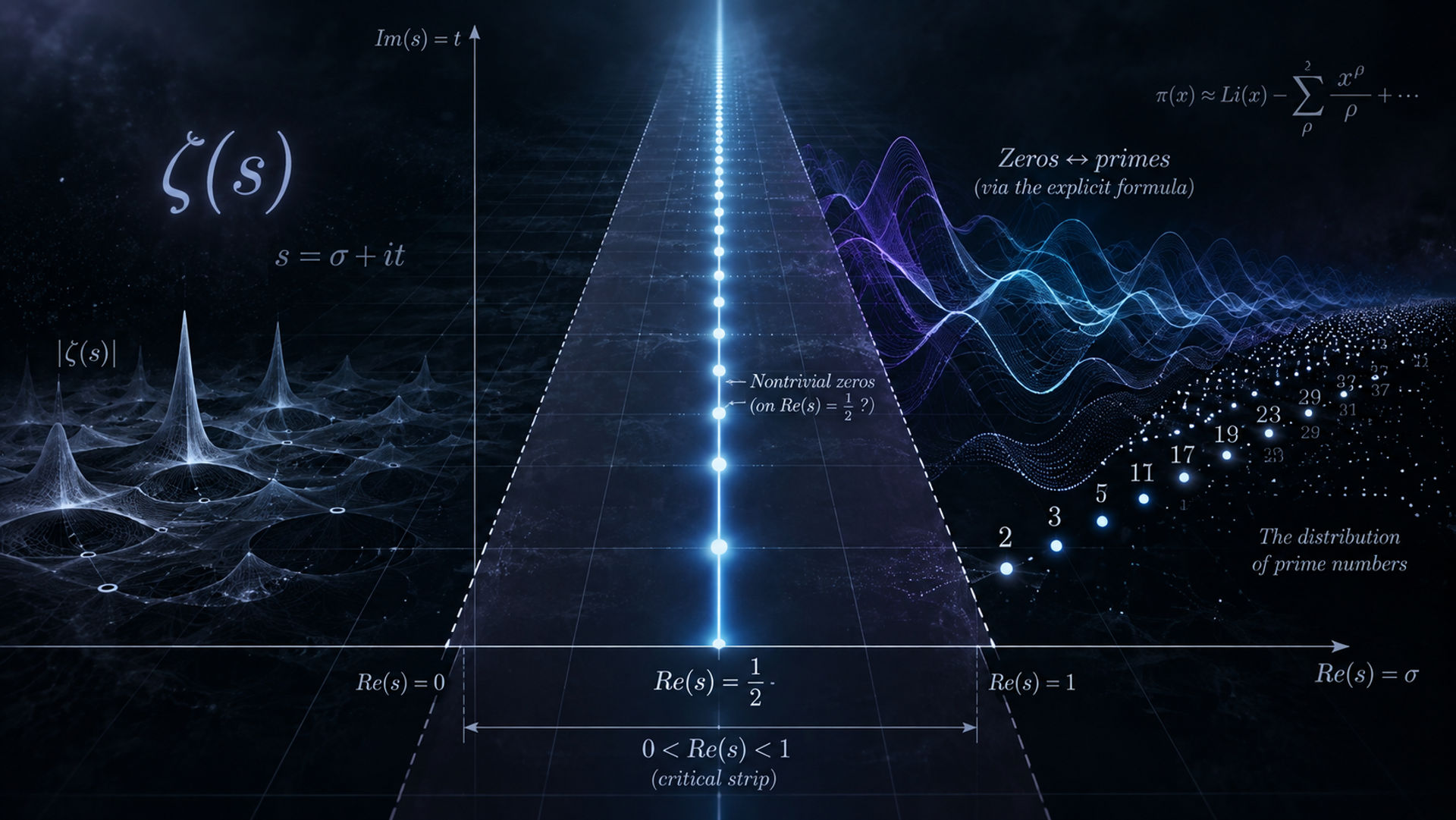
A rigorous accounting of proven theorems, computational evidence, and 2026's record-breaking bound — not another 'is it finally solved?' piece
What is rigorously proven about the Riemann Hypothesis, what recent record-breaking results actually show, and why the...

The German mathematician's proof of the Mordell conjecture — and decades of structural insight — earn mathematics' highest honour
Gerd Faltings has been awarded the 2026 Abel Prize for introducing powerful tools in arithmetic geometry and resolving...