research11 min read
The Riemann Hypothesis: A 2026 Status Report
The greatest unsolved problem in mathematics

The greatest unsolved problem in mathematics
There is a certain class of mathematical problem whose importance grows rather than diminishes with the passage of time. The Riemann Hypothesis belongs firmly in this class. Proposed in a single eight-page memoir by Bernhard Riemann in 1859 — a paper titled Über die Anzahl der Primzahlen unter einer gegebenen Größe ("On the number of primes less than a given quantity") — it has resisted the sustained assault of brilliant mathematical minds across four generations. It stands today as one of the seven Millennium Prize Problems, carrying a one-million-dollar reward from the Clay Mathematics Institute, and it is the only one of those seven with the added distinction of appearing on Hilbert's famous 1900 list of problems for the twentieth century.
But prize money is a distraction from what really makes the hypothesis important. The Riemann Hypothesis is the precise quantitative statement that controls the distribution of prime numbers among the integers. Primes appear to scatter through the integers in a pattern that is simultaneously comprehensible in the large — described by the Prime Number Theorem, proved independently by Hadamard and de la Vallée Poussin in 1896 — and deeply irregular in the small. The hypothesis, if true, would say that this irregularity is as controlled as it possibly can be: the error in our best approximation to the prime-counting function is bounded by essentially . This would be optimal.
"If I were to awaken after having slept for a thousand years, my first question would be: has the Riemann Hypothesis been proved?" — David Hilbert
The story begins with a function that looks, at first glance, almost absurdly simple. For a real number , define the Riemann zeta function by the Dirichlet series:
The series converges absolutely for . Euler had already studied this function in 1737 and proved a remarkable identity connecting it to the prime numbers — the Euler product formula:
This is the fundamental bridge between analysis and arithmetic. The product runs over all primes, and it encodes the Fundamental Theorem of Arithmetic: every positive integer factors uniquely into primes, and the product formula is precisely the multiplicative bookkeeping of this fact. From the divergence of the harmonic series (), Euler deduced the infinitude of primes — but far more than Euclid's original argument, his approach gives quantitative information about how many primes there are.
Riemann's profound contribution in 1859 was to consider not as a real number but as a complex variable, with . The series still converges absolutely for , defining a holomorphic function there. Riemann then showed — using contour integration and the functional equation for the Jacobi theta function — that extends to a meromorphic function on all of , with a single simple pole at with residue . The extended function satisfies a beautiful symmetry known as the :
The completed zeta function is entire (no poles) and satisfies . The symmetry axis is inescapable: .
The zeros of come in two kinds. The trivial zeros occur at the negative even integers , arising from the poles of the Gamma function in the functional equation. They are well-understood and carry no arithmetic content.
The interesting zeros — the nontrivial zeros — lie in the open vertical strip called the critical strip:
No nontrivial zero can lie outside this strip: the Euler product shows for , and the functional equation then forces the same for (outside the trivial zeros). Inside the strip, functional-equation symmetry implies that if is a zero then so are , , and — the nontrivial zeros come in symmetric groups about both the real axis and the critical line .
Nontrivial zeros are conventionally written where . The first zero above the real axis — computed by Riemann himself — has imaginary part approximately:
In 1896, Hadamard and de la Vallée Poussin each proved that there are no zeros on the boundary line . This is equivalent to the Prime Number Theorem. But the entire interior of the critical strip remains open territory. The Riemann Hypothesis asks whether all nontrivial zeros lie on the central critical line .
The connection between zeros and primes is made explicit through the explicit formulas of analytic number theory. Define the Chebyshev function:
where is the von Mangoldt function — equal to when is a prime power , and zero otherwise. The function captures the same information as the prime-counting function but is smoother and more tractable analytically.
Riemann's explicit formula, made rigorous by von Mangoldt in 1895, gives:
where the sum runs over all nontrivial zeros ordered by imaginary part. This is one of the deepest equations in all of mathematics. It says, in precise terms, that the prime numbers are a superposition of waves — one for each zero of the zeta function. The zero contributes a term which oscillates with frequency and has amplitude .
The dominant term is — the smooth main term. The deviation of from is entirely controlled by the real parts of the zeros. If all nontrivial zeros satisfy , then each contribution has size , and the full sum gives a total error bounded by . This translates to the following sharpened form of the Prime Number Theorem, conditional on RH:
where is the logarithmic integral. Without RH, the best unconditional error term has the form , giving essentially no power savings over the main term in practice.
The explicit formula reveals a striking phenomenon: the fluctuations of around its mean, when Fourier-analysed, exhibit peaks at precisely the imaginary parts of the zeros. The zeros of the zeta function are literally the frequencies of the prime numbers.
Precise statement:
All nontrivial zeros of the Riemann zeta function satisfy . That is, every nontrivial zero has the form for some real .
One of the most striking features of the hypothesis is the number of equivalent reformulations it admits, drawing together threads from across mathematics.
Li's criterion (1997). Xian-Jin Li proved that RH is equivalent to the nonnegativity of an explicit sequence of real numbers defined by derivatives of at :
Robin's inequality (1984). The Riemann Hypothesis is equivalent to the elementary-looking inequality:
where is the sum of divisors of and is the Euler–Mascheroni constant.
Möbius function bound. RH is equivalent to for every , connecting RH to the apparent randomness of the Möbius function: the hypothesis says, in essence, that behaves like a fair coin flip.
Beurling–Nyman criterion. RH is equivalent to a density statement in : the characteristic function of lies in the closed linear span of the dilations of the fractional-part function .
There are now well over fifty known equivalent formulations spanning number theory, functional analysis, operator theory, and combinatorics. This deep interconnectedness is itself a sign of the hypothesis's centrality.
While a proof remains elusive, the past century has produced a substantial body of partial results and structural understanding.
Hardy (1914) proved that infinitely many nontrivial zeros lie on the critical line — the first unconditional result placing any zeros there, though giving no density information.
Selberg (1942) proved that a positive proportion of nontrivial zeros lie on the critical line, a significant quantitative strengthening.
Levinson (1974) introduced a new zero-detection technique — the method of mollifiers — and proved that at least of all nontrivial zeros lie on the critical line.
Conrey (1989) refined Levinson's method and pushed the proportion to at least (40%). This remains among the best unconditional lower bounds available in 2026.
Montgomery's pair correlation conjecture (1972). Hugh Montgomery studied the statistical distribution of gaps between consecutive zeros and discovered that it matches the eigenvalue spacing distribution of large random unitary matrices from the Gaussian Unitary Ensemble (GUE). Sharing this observation with Freeman Dyson over tea at the Princeton Institute for Advanced Study, Montgomery inaugurated the deep connection between RH and random matrix theory.
Odlyzko's numerical confirmation (1980s–90s). Andrew Odlyzko performed extensive computations confirming that the spacing statistics of zeros match GUE predictions to extraordinary precision, even for zeros near height on the critical line.
Keating–Snaith (2000). Using random matrix theory, Jonathan Keating and Nina Snaith derived precise conjectural formulas for the moments of that match numerical data to remarkable accuracy and suggest a deep structural reason why zeros accumulate on the critical line.
A crucial structural result, due to Backlund and made computationally decisive by Turing, is the zero-counting formula. The number of nontrivial zeros with is:
where is bounded on average and fluctuates with r.m.s. of order . This allows exact counting of zeros in any interval and verification that each lies on the critical line.
One of the most striking (though logically inconclusive) pieces of evidence for the Riemann Hypothesis is the scale of numerical verification.
It has further been verified that there are no zeros off the critical line with imaginary part up to approximately .
It must nonetheless be stressed that no numerical evidence, however vast, constitutes a proof. The Mertens conjecture — the stronger statement for all — held computationally for all tested values before Odlyzko and te Riele disproved it in 1985. A counterexample to RH could in principle lie at heights utterly beyond computational reach.
The moments conjecture of Keating–Snaith predicts:
for arithmetic factors and involving Barnes G-functions. The conjecture has been proved for and (classical results) and is supported numerically for several rational . Work of Soundararajan and Harper establishes matching upper bounds conditionally. The structure of the moments appears to encode — in a sense being made increasingly precise — the hypothesis that zeros are on the critical line.
The Hilbert–Pólya conjecture asserts that the imaginary parts of the nontrivial zeros are eigenvalues of a self-adjoint operator on some Hilbert space. Since eigenvalues of self-adjoint operators are real, and the functional equation would then force , this would imply RH immediately.
The GUE statistics observed by Montgomery–Odlyzko match those of quantised chaotic Hamiltonians, suggesting a connection with quantum chaos. Berry and Keating proposed a formal model: the classical Hamiltonian (in position-momentum representation), quantised with appropriate boundary conditions, appears to reproduce the zero statistics. A rigorous construction remains unavailable, but the correspondence continues to guide research.
Alain Connes reformulated RH using adelic methods and noncommutative geometry. In his approach, the Weil explicit formula is interpreted as a trace formula for an operator on a certain adèlic space, and RH becomes a positivity condition — directly analogous to the Riemann Hypothesis for function fields, which follows from the Weil conjectures and Grothendieck's étale cohomology. Over finite fields, the relevant zeta function is a polynomial; its zeros are controlled by the Frobenius endomorphism, a linear operator with eigenvalues of known absolute value. The challenge for the classical case is to construct the analogous operator.
Work of Connes and Consani through the mid-2020s continues to develop this programme, identifying new connections between the Weil explicit formula, the multiplicative action of on the adèle class space, and tropical geometry.
The best known unconditional zero-free region for has the form for an explicit constant . Sharpened constants obtained by Mossinghoff, Trudgian, and Yang (2022–2024) have improved explicit estimates in prime number theory.
The de Bruijn–Newman constant offers a complementary measure of how close RH is to the boundary of truth. A family of deformed entire functions has only real zeros for ; RH is equivalent to . A landmark result of proved , establishing that RH is : any perturbation of the zeta function of this type that moves zeros off the critical line does so immediately at . Platt and Trudgian (2021) computed numerically that . Taken together: if and only if RH holds, and is extremely close to — possibly equal to — zero.
The Riemann zeta function is the simplest instance of an automorphic -function, the class of complex functions central to the Langlands programme. The Generalised Riemann Hypothesis (GRH) conjectures that all nontrivial zeros of all automorphic -functions lie on their respective critical lines. Advances in the Langlands programme — including modularity lifting theorems and progress on functoriality — steadily expand the collection of -functions for which deep properties are accessible, offering potential new leverage on zero distribution.
The rapid development of AI-assisted reasoning and formal verification has prompted genuine discussion about whether these tools could contribute to a proof. The picture is nuanced.
In formal proof verification, the Lean 4 Mathlib library now contains a machine-checked proof of the Prime Number Theorem and is actively formalising large portions of analytic number theory. If a proof of RH were found, it could in principle be fully verified mechanically, eliminating the possibility of subtle errors in what would almost certainly be a very long argument.
AI tools — large language models, symbolic reasoning systems, and conjecture-generation platforms like the Ramanujan Machine — can serve as research accelerators, helping mathematicians explore the literature, identify analogies across subfields, and navigate the extensive web of equivalent reformulations. Whether current systems can generate the kind of structural insight a proof of RH would require is a different question. The bottleneck is not a shortage of equivalent formulations or conjectures; it is the absence of the right framework. Today's AI systems excel at pattern recognition within known mathematics but have not yet demonstrated the capacity for the structural innovation such a proof demands.
The most plausible near-term contribution is interactive theorem proving: a human mathematician working in close dialogue with a proof assistant, with AI tools helping to explore the search space, formalise intermediate steps, and catch errors early. This mode of working is maturing rapidly and may well be central to the eventual resolution of the major open problems in analytic number theory.
The Riemann Hypothesis matters on at least three levels.
At the most immediate level, it is a precise statement about the distribution of the prime numbers — the irreducible building blocks of arithmetic — that we strongly believe to be true and cannot prove. The primes are as old as mathematics itself, and our inability to pin down the fine structure of their distribution is a fundamental gap in our understanding of number.
At a deeper level, the hypothesis sits at the centre of a web of connections between fields that superficially seem unrelated: complex analysis, spectral theory, random matrix theory, quantum mechanics, algebraic geometry over finite fields, and the Langlands programme. Any serious engagement with RH illuminates all these connections simultaneously.
At the deepest level, the Riemann Hypothesis is a test of our methods. A proof — whenever it arrives — will almost certainly require either a fundamentally new approach to analytic number theory, or the successful transplantation of a technique from another domain, most plausibly the spectral and geometric methods that worked so decisively in the function-field setting.
In 2026, after 167 years, the Riemann Hypothesis remains open. Twenty trillion zeros are confirmed on the critical line. The de Bruijn–Newman constant is pinned at , the sharpest boundary possible. The random matrix connection is more precise and predictive than ever. Formal proof systems are, for the first time, approaching the sophistication needed to handle arguments of the requisite complexity.
The primes have a music. The Riemann Hypothesis says that music is as pure and regular as it can possibly be. We can hear the harmony; what we seek is the instrument that produces it.
Foundational texts
Key research papers
Surveys and expositions

Applied mathematician and AI practitioner. Founder of MathLumen, exploring mathematics behind machine learning and scientific AI.
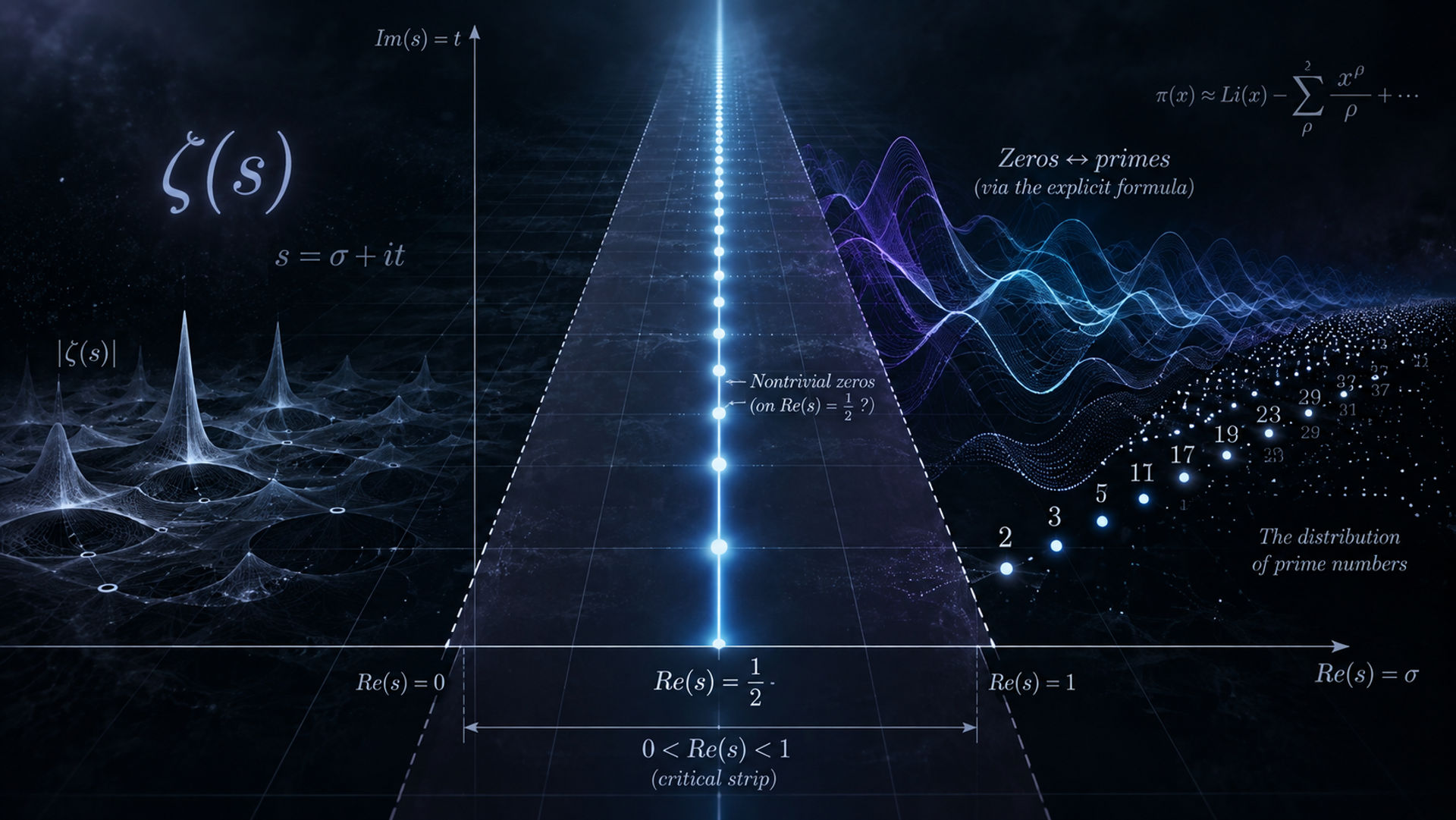
A rigorous accounting of proven theorems, computational evidence, and 2026's record-breaking bound — not another 'is it finally solved?' piece
What is rigorously proven about the Riemann Hypothesis, what recent record-breaking results actually show, and why the...
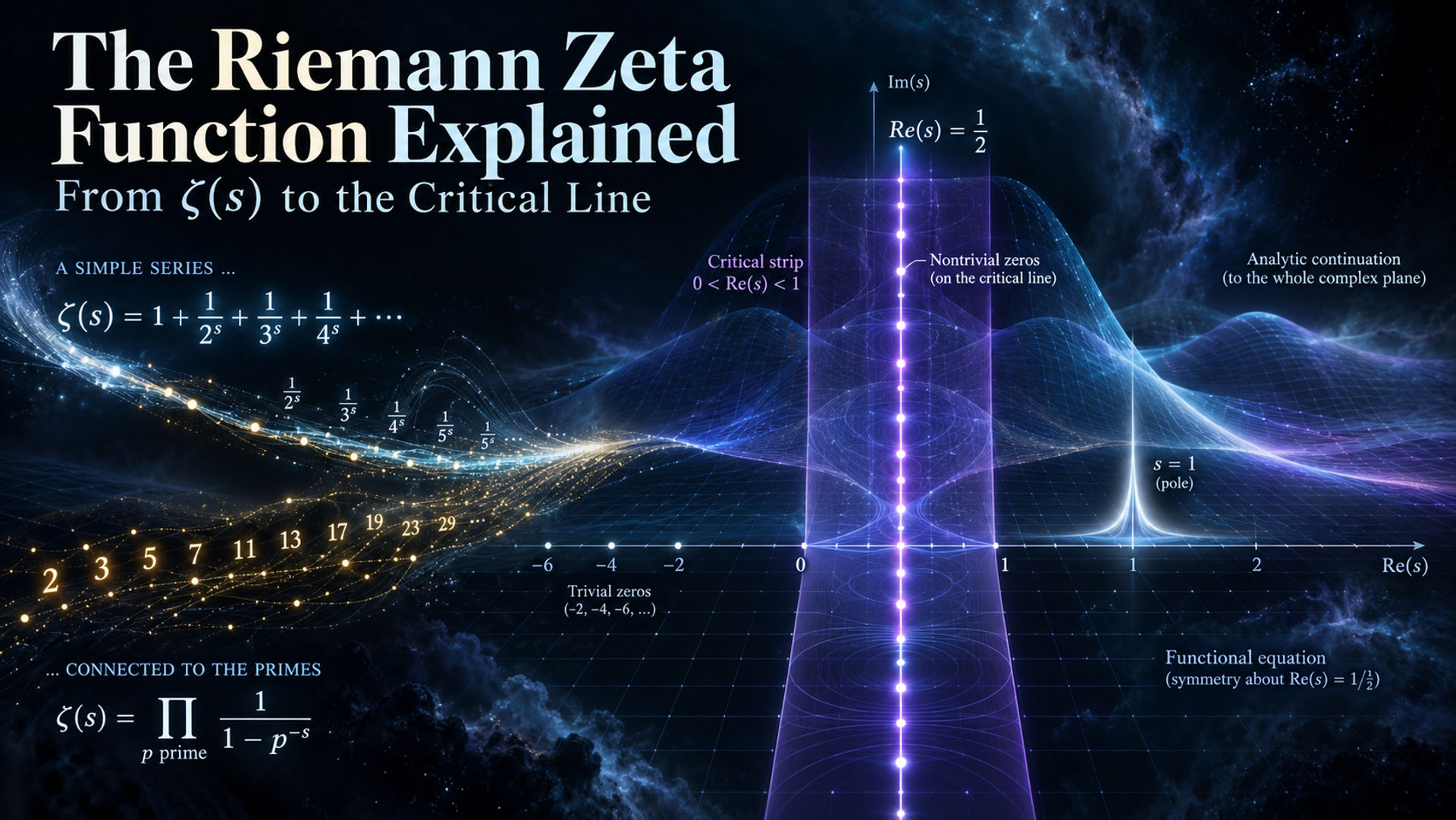
A first-principles primer on the function that ties prime numbers to the geometry of the complex plane
Starting from a simple infinite sum, we build up the Riemann zeta function, its analytic continuation, and the critical...

Superhuman engines have mastered practical chess. Mathematics has not yet proven what perfect chess is.
Stockfish and AlphaZero have mastered practical chess, but its true value under perfect play remains formally unproven...