history8 min read
Emmy Noether and the Theorem That Changed Physics
How an algebraist revealed the deepest structure of physical law

How an algebraist revealed the deepest structure of physical law
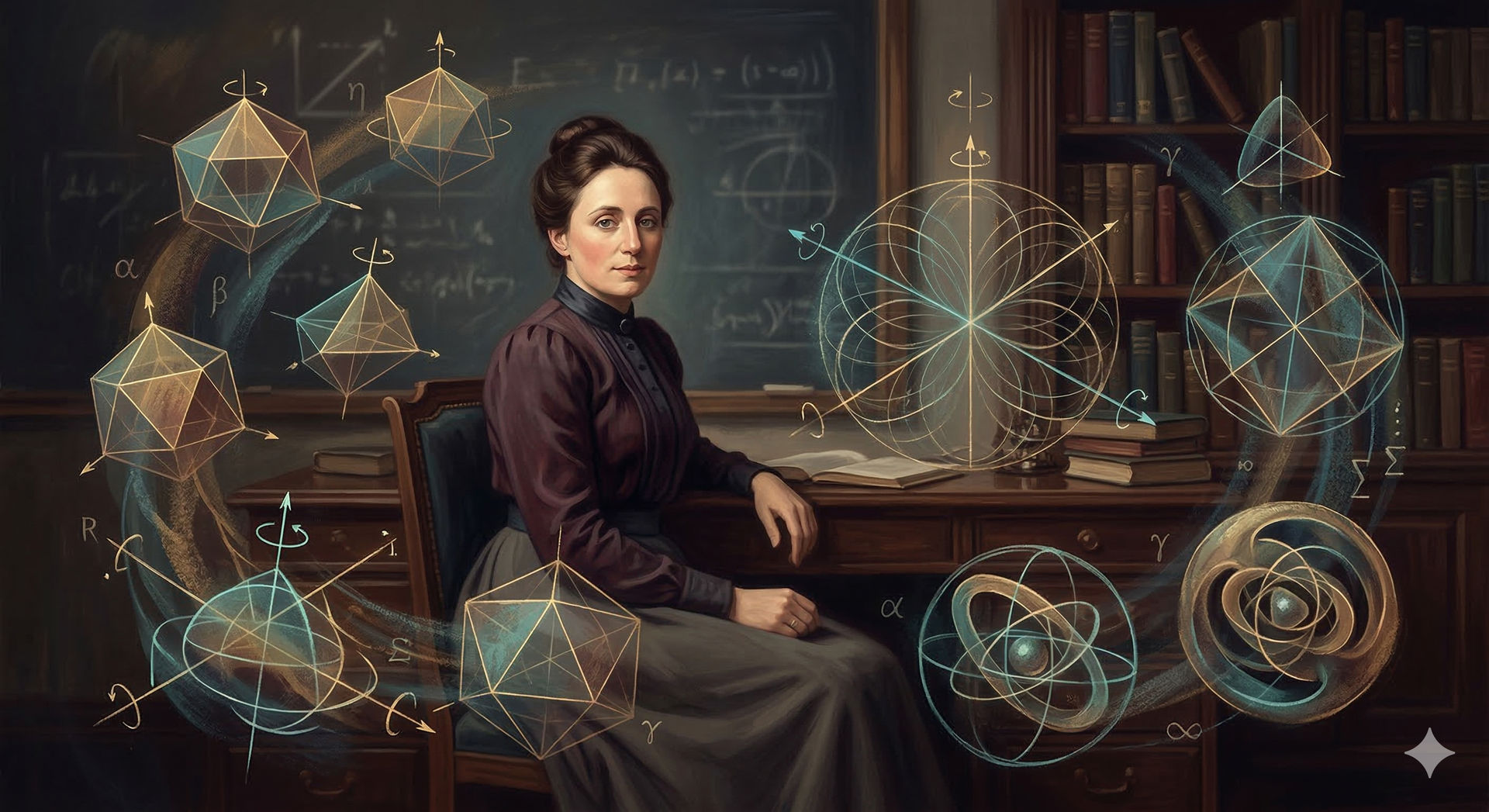
There is a class of mathematical results so structurally clean that they do not merely solve a problem — they dissolve an entire category of problems by revealing that what appeared to be many separate facts is actually one fact, seen from different angles. Emmy Noether's 1918 theorem is of this character.
Before Noether, the conservation of energy, the conservation of momentum, and the conservation of angular momentum were three independent empirical pillars of physics — confirmed by experiment, assumed as axioms, but not derived from anything deeper. After Noether, they became theorems. Each one follows inevitably from a corresponding symmetry of physical law, and the logical machinery that connects them is the same in every case.
The theorem states, with full precision, what physicists had only vaguely sensed: that the laws of nature are governed not by arbitrary rules but by geometric structure. That the universe conserves energy not as a brute fact, but because its laws do not change from one moment to the next. That momentum is conserved because no location in space is physically distinguished from any other.
This is among the most beautiful results in all of mathematical physics. And it was proved by a woman who was not permitted to hold a faculty position, who lectured for years under a colleague's name, and who died in 1935 before the physics community fully understood what she had given it.
Amalie Emmy Noether was born on 23 March 1882 in Erlangen, Bavaria, the eldest child of Max Noether — himself a distinguished algebraist and professor at the University of Erlangen. The household was mathematically saturated from the start. It did not, however, provide immunity from the institutional hostility that would shape her entire career.
At the time of her early studies, the University of Erlangen formally barred women from enrolling. She was permitted to audit lectures only with individual professors' consent — a concession, not a right. She nonetheless passed the Bavarian state examinations qualifying her for university work, and when policies loosened she enrolled properly, earning her doctorate in 1907 under Paul Gordan with a dissertation on invariant theory.
Her early work sat within the classical tradition of computing systems of algebraic invariants — important, technically demanding, and already somewhat old-fashioned by the standards of the Hilbert era. Something changed over the following decade, a shift from computation toward abstraction that would define modern algebra. When David Hilbert invited her to Göttingen in 1915, she arrived at the centre of world mathematics at a moment of genuine intellectual crisis.
The Göttingen faculty senate refused to grant her a Habilitation — the qualification required for independent lecturing. Hilbert's response has entered mathematical legend: "I do not see that the sex of the candidate is an argument against her admission as Privatdozent. After all, we are a university, not a bathing establishment." He did not immediately prevail. For several years, Noether's courses were listed in the university calendar under Hilbert's name, with a note that he would be "assisted" by Dr. Noether.
She remained at Göttingen until April 1933, when the Nazi regime's Law for the Restoration of the Professional Civil Service removed Jews and political undesirables from academic posts. She was among the first dismissed. Within months she had accepted a position at Bryn Mawr College in Pennsylvania, where she also lectured at the Institute for Advanced Study in Princeton. She died suddenly on 14 April 1935 following surgery for an ovarian cyst, at fifty-three. Albert Einstein wrote in The New York Times four days later that she was "the most significant creative mathematical genius thus far produced" — adding, pointedly, that her work had been produced under conditions that would have extinguished a lesser mind.
To understand why Hilbert sought Noether's help with physics rather than algebra, one must understand the particular difficulty that Einstein's general relativity posed for energy conservation.
In Newtonian mechanics, and in special relativity, energy conservation is straightforward: the energy of an isolated system is a definite, calculable quantity that does not vary with time. The derivation relies on the fixed, flat background of Minkowski spacetime — an unchanging arena in which the drama of physics plays out.
General relativity dissolves that arena. Gravity, in Einstein's theory, is the curvature of spacetime itself, encoded in the metric tensor , which is a dynamical field — it evolves in response to the distribution of matter and energy, according to
where is the Einstein tensor encoding spacetime curvature and is the stress-energy tensor of matter. When the background geometry is not fixed but itself evolving, the standard derivation of global energy conservation fails. One can write down expressions that look like energy density, but they transform poorly under changes of coordinates — their values depend on the observer in ways that strip them of invariant physical meaning.
Hilbert and Felix Klein were disturbed by a specific structural observation: the contracted Bianchi identity of differential geometry forces as a mathematical identity, independent of the field equations. Combined with those equations, this gives — the local conservation of the stress-energy tensor. Yet this appeared to make energy conservation a rather than a dynamical law, and its meaning for global, integrated quantities remained thoroughly obscure.
They needed someone who combined deep facility with the calculus of variations, invariant theory, and differential geometry. They needed someone who could identify, at the structural level, exactly what kind of mathematical object was responsible for the behaviour they were seeing. They needed Noether.
Her analysis showed that the difficulty was not a defect of general relativity but a consequence of its most central feature: general covariance, the invariance of the theory under arbitrary smooth coordinate transformations. This is an infinite-dimensional symmetry group, and Noether's second theorem (a companion to the famous first theorem, and considerably less celebrated) shows that when the symmetry group is infinite-dimensional, the associated conservation equations degenerate into identities — relations that hold automatically on account of the equations of motion, without encoding independent physical information. The "missing" energy conservation of general relativity was not missing at all. It had been transformed, by the vast symmetry of the theory, into something qualitatively different.
This was the resolution. It would take decades for the physics community to fully absorb it.
Before the theorem itself, we need the vocabulary it operates in.
A symmetry of a physical law is a transformation of the system that leaves the law unchanged. The laws of electromagnetism are the same in London as in Mumbai — spatial position is not a physically distinguished variable. The laws of mechanics are the same this morning as they were last Tuesday — time does not have a preferred origin. These are symmetries: transformations (shift the spatial origin; shift the temporal origin) under which the physics is invariant.
More precisely, for a system described by generalised coordinates , one defines the Lagrangian — encoding the difference between kinetic and potential energy — and the
The physical trajectory is the one that makes stationary under small variations: . This yields the Euler–Lagrange equations
which are the equations of motion. A symmetry, in this language, is a continuous family of transformations parameterised by a small real number under which the action is invariant (or changes only by a boundary term).
The key word is continuous. A discrete symmetry — replacing by , for instance — does not in general yield a conserved quantity via Noether's mechanism. A continuous symmetry can be infinitesimally generated, and it is this infinitesimal generator that produces the conserved charge.
For each coordinate , define the conjugate momentum
The Euler–Lagrange equations become . A conserved quantity is one whose total time derivative vanishes along every solution.
Noether's First Theorem (1918). Suppose the Lagrangian is invariant — up to a total time derivative — under the one-parameter family . Then the quantity
satisfies on every solution of the equations of motion.
The proof is a clean computation. Differentiating the invariance condition with respect to and evaluating at gives
Rewriting the left side by integration by parts:
The second sum is zero whenever the equations of motion hold. Therefore .
The elegance is structural: the conserved quantity is read off from the symmetry generator . No integration over space, no appeal to boundary conditions, no guesswork. The symmetry tells you, algebraically, what is conserved.
The power of the theorem becomes concrete in the three examples that every physicist encounters.
Time-translation symmetry and energy. Suppose — the Lagrangian has no explicit time dependence. The system is then invariant under , which sends , so . The Noether charge is
the Hamiltonian, which equals the total energy for standard mechanical systems. The laws of physics do not change with time, therefore energy is conserved. The converse holds equally: any violation of energy conservation would imply a genuine time-dependence of the laws of nature.
Spatial-translation symmetry and momentum. Suppose a system of particles with positions has a Lagrangian invariant under for all simultaneously. Then for each particle, and
where is the total momentum. Since this holds for every direction , the entire momentum vector is conserved. No location in space is physically distinguished, therefore total momentum is conserved.
Rotational symmetry and angular momentum. Under an infinitesimal rotation about axis by angle :
so . The Noether charge is
the component of total angular momentum along . Invariance in all directions gives conservation of the full angular momentum vector. No direction in space is physically distinguished, therefore angular momentum is conserved.
Three pillars of classical physics, derived in three lines each, from three geometric properties of space and time.
The transformation was not immediate. Noether's paper was read by mathematicians concerned with general relativity and largely ignored by the wider physics community for decades. The full significance emerged gradually, as quantum mechanics and then quantum field theory forced physicists to think seriously about symmetry.
In quantum mechanics, the Noether correspondence becomes an operator statement. A conserved charge satisfies — it commutes with the Hamiltonian. States of definite form irreducible representations of the symmetry group. The quantum numbers that classify particles — charge, spin, isospin, baryon number, lepton number — are precisely the eigenvalues of Noether charges associated with the internal symmetries of the quantum fields.
In quantum field theory, the theorem becomes a statement about currents. For a field with a continuous symmetry, there exists a four-current satisfying the continuity equation
and the conserved charge is . The Ward–Takahashi identities of quantum electrodynamics — which control the renormalisability of the theory and relate different Green's functions — are the quantum versions of Noether conservation equations.
The deepest application is to gauge theories. The Standard Model of particle physics is, at its conceptual core, a specification of a symmetry group:
The entire interaction content of the theory — the existence of photons, and bosons, and gluons, their coupling strengths, and the structure of the electroweak and strong forces — follows from demanding invariance under local transformations: symmetries whose parameters vary from point to point in spacetime. When one imposes this local invariance, the Lagrangian forces the introduction of new dynamical fields (the gauge bosons) to compensate for the spatially varying phases. The photon does not appear as an empirical postulate. It appears because the theory would otherwise not be invariant.
Noether's theorem is what makes this logical chain rigorous. The conserved charges of the gauge symmetry are the electric charge, the weak isospin, and the colour charges that classify every particle in the Standard Model. The theorem connects the geometry of the symmetry group to the arithmetic of particle physics.
Noether's influence on physics, remarkable as it is, represents perhaps half of her mathematical legacy. The other half is a revolution in algebra whose consequences are at least as far-reaching.
In the early twentieth century, algebra was a collection of techniques — methods for polynomial equations, quadratic forms, determinants, and the classical theory of invariants. Noether showed that the deep structure lay not in these computations but in the abstract relationships between algebraic objects: the ideals of a ring, the modules over a ring, and the conditions under which these objects behave well.
Her 1921 paper Idealtheorie in Ringbereichen established the primary decomposition of ideals in what we now call Noetherian rings — rings satisfying the ascending chain condition: every chain of ideals eventually stabilises. This condition, named in her honour, is satisfied by all principal ideal domains (including and polynomial rings over a field ), and it guarantees that every ideal admits a finite decomposition into primary components — a vast generalisation of unique prime factorisation. Algebraic geometry depends on this result at a foundational level; the decomposition of a variety into irreducible components is its geometric shadow.
Her work through the 1920s on representation theory replaced the older matrix-based approach with an abstract module-theoretic language that is now the default vocabulary of the subject. Her correspondence with Helmut Hasse and Emil Artin directly influenced the development of class field theory. Hermann Weyl, in his memorial address, credited her with introducing the modern axiomatic style into algebra — a style so effective that within a generation it was simply how algebra was done, its origin quietly forgotten.
Recognition came slowly and, by any reasonable standard, incompletely.
Einstein's New York Times letter remains the most prominent contemporary acknowledgement from the physics side. Weyl's memorial address is more technically revealing, describing her influence on younger mathematicians as decisive and her personal manner as combining complete absence of vanity with absolute conviction about mathematics. The two portraits together — the physicist's awe and the mathematician's precision — give a fuller sense of her standing among those who understood her work.
The physics community's recognition developed in parallel with the development of gauge theory. Yang and Mills's 1954 paper on non-Abelian gauge fields, which laid the foundation for the Standard Model, is an application of the Noether framework to internal symmetry groups, though neither author emphasised this connection explicitly. By the 1970s, when the Standard Model was assembled and its renormalisability established, it was impossible to state the theory without implicitly invoking Noether's theorem on every page.
Institutional recognition has accumulated gradually: asteroid 7001 Noether, the Emmy Noether Programme of the Deutsche Forschungsgemeinschaft, a growing body of historical scholarship on her work and circumstances. None of this reverses the decades she spent without a salaried position, lecturing under another's name, in a discipline that refused to grant her the standing her work had earned.
More recently, her second theorem has attracted renewed attention in connection with gravitational wave physics and the asymptotic symmetry groups of general relativity. The Bondi–Metzner–Sachs (BMS) group — an infinite-dimensional symmetry of asymptotically flat spacetimes that controls the structure of gravitational radiation — is precisely the kind of object Noether's second theorem was built to analyse. The soft theorems of quantum gravity, and their proposed connection to black hole information via the work of Hawking, Perry, and Strominger, turn on the Noether structure of these asymptotic symmetries. Her 1918 paper, written to resolve a question in general relativity, turns out to bear directly on one of the central open problems in theoretical physics today.
The deepest lesson of Noether's theorem is philosophical as much as technical. Conservation laws are not brute facts about the world, confirmed by experiment and enshrined by repetition. They are consequences — of the geometry of spacetime, of the symmetry properties of the laws that govern matter and energy. To ask why energy is conserved is to ask why the laws of physics do not change with time. To ask why momentum is conserved is to ask why one point in space is physically equivalent to any other. The questions are the same question.
This inversion — from axiom to theorem, from empirical postulate to geometric consequence — is the mark of a fundamental result. It does not merely answer a question. It reveals that the question, properly understood, had a much more illuminating answer than anyone had imagined.
That this result came from a mathematician who was systematically excluded from the institutions that claimed ownership of mathematical knowledge is worth holding in mind — not as historical consolation, but as a reminder of what those exclusions cost. Mathematics does not stop being true because its author is barred from the faculty meeting. Emmy Noether's theorem was true in 1918. It remains the foundation on which modern theoretical physics is built. The asymmetry between the theorem's permanence and its author's precarious institutional existence is a fact that the history of mathematics has not yet fully reckoned with.

Applied mathematician and AI practitioner. Founder of MathLumen, exploring mathematics behind machine learning and scientific AI.
The extraordinary formulas that arrived in letters from Madras
Srinivasa Ramanujan produced formulas for 1/π of staggering complexity and beauty — with no formal proofs. We trace the...
A rigorous accounting of proven theorems, computational evidence, and 2026's record-breaking bound — not another 'is it finally solved?' piece
What is rigorously proven about the Riemann Hypothesis, what recent record-breaking results actually show, and why the...

The German mathematician's proof of the Mordell conjecture — and decades of structural insight — earn mathematics' highest honour
Gerd Faltings has been awarded the 2026 Abel Prize for introducing powerful tools in arithmetic geometry and resolving...